Search This BlogRustic furniture

Showing posts with label swarm. Show all posts

2 June 2018

An Oasis of Calm Bees

My brother and I both keep bees in home-made hives, but in very different locations. His are in two separate locations, one Warre hive sits at the bottom of his south facing hilltop garden, the others are out on an acre of fairly steep ground that overlooks the beautiful Teign Estuary facing south. The Warre is a tall, multi-layered structure with four oval shaped observation windows on the north face. This week Andrew's Warre had a super top and bottom added making the hive about six feet tall. Already the bees are seen to be making fresh comb.  The other two hives at the outfield are thriving but left relatively undisturbed as they would be in the natural state.
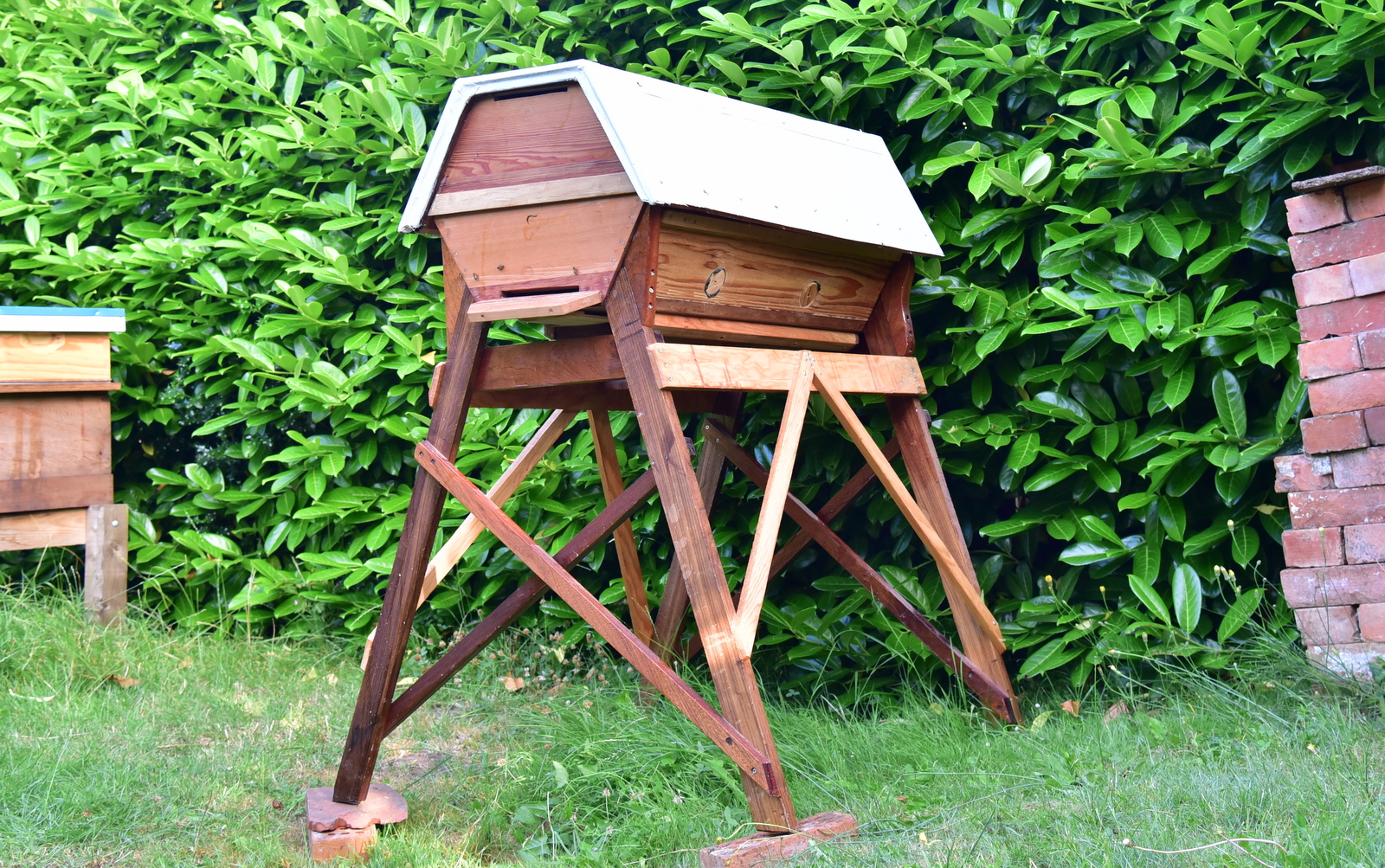
Neither of us is fussed to harvest honey as the motivation for working with bees - the subject is more to do with the variety of tasks we set ourselves; from catching a swarm, to puzzling out the best way to fabricate the bee house. Andrew prefers to secure his hives with guy rope straps fixed with stakes,  I prefer to mount the hive on a wider base, and rely on the weight alone, for it to stay put.
My plan to get a "Bailey Transfer" movement mentioned in a previous post has suddenly been put on hold, due to a secondary swarming from one of the other hives. Yesterday evening I had a shout to say a large swarm had settled in the Willow thicket - come quick. So it was that I came to box them up, after a balancing act on a fence below the branch that was about twelve feet off the ground. They were captured complete with a section of the branch, once it had been pruned down to go into a box.
Conveyed the short distance to the Apiary they were then deposited into the upper hive, still perched on top of a flat top-bar hive. The window between the two hives has been temporarily filled with a folded up towel to prevent squabbling, and today I shall be there  again to see if all is well. The swarm is small and hopefully will combine with the colony below. Sunday dawns warmer than yesterday but his afternoon I learnt the swarm caught yesterday had already absconded so its back to plan "A" ....The hive below is the most active.
Andrew has helped me out a few times but yesterday was out when I called him. He is unsure of his way to my out apiary. Several miles out into a steep sided valley that runs from the Haldon hills down to the sea. High Devon hedges, cross-roads,  blind bends, many potholes and green lane running water, slow progress to a walking pace much of the way.   Once there, it is a hideaway oasis of calm, where even the birdsong is gentle on the ear.
 

,

24 August 2016

Bee Trap Out to bag a colony

Probably too late to capture the colony no. 2 due to a natural swarming out of the barn wall.
My hopes for bees from out of the masonry diminished yesterday.

A trap hive was hauled to the top of a ladder, set against the barn and a mesh funnel deployed over the colony exit. Wasps were seen raiding the depleted nest. A colony defenceless compared to the week before.
Meanwhile the Cathedral Top Bar Hive thrives. The following video shows all the bars removed except those holding comb. The two jars of syrup have just been re-filled and the varroa tray beneath the wire mesh floor temporarily removed, to allow some bees to escape. They had somehow found a way under, despite my best efforts to make it proof against such an event.

 Apologies for the noisy clicking camera focus.
The combs nearest the camera are relatively new, those farthest away and now expanded almost the full extent of the width available, contain brood and will soon be hatching the worker bees that will hopefully overwinter through to early spring of next year.  Five combs just two weeks ago have expanded and seven combs are showing - probably double the overall comb area.


10 August 2016

Newly deployed Cathedral Top Bar Hive

The bees are in charge at hive No 1 and reminded me with a full on attack to my forehead at 5.30pm today. Their mood seemed much altered from the earlier days of settling in to their location in Courtenay's garden. The wind is fresh from the south east. Honey stores and brood are building well and they have much more at stake to defend.  Latest Images
At the outlying site farther afield hive No 2 is also deployed, in addition to a bait hive, which is located just below a colony deep within the brickwork of a farm building.
Almost immediately the scouts began investigating the two hives, so I was hopeful they would choose to move in. After waiting several days and with no progress towards a move by the bees, I plan to use a trap out method for their removal from the barn.  Plan B will involve the use of a one-way funnel to allow escape but prevent re-entry through the hole in the wall. The bait hive is to be deployed close to the funnel base and the bees hopefully will choose to move inside, including the queen with any luck. 

This late in the year they will need feeding and ongoing support through the winter months in order to boost any chance of survival.

Bees within the brickwork of the studio / barn.


Allowing trapped bees to escape. The dark patches here seen along the joint line between brickwork and blockwork are the bees at their entry point. 


Vacuuming the bees was not successful - Several perished - Entry/exit point inside sealed up.


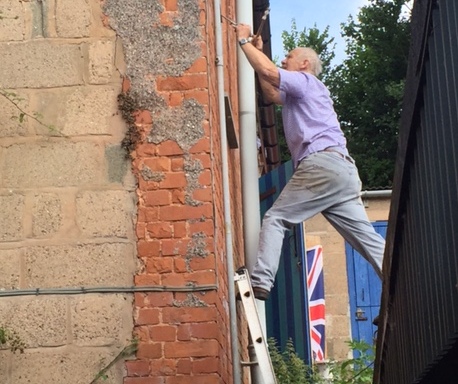
A rescue operation was first accomplished of bees trapped inside the building., They could find no escape from behind the non opening window. The method was removal of a pane of glass reachable by shinning up an extending ladder.


Half size bait hive attracts attention but since removed for minor alterations pending the trap out.


A trap out will be required to re-locate this colony. The window pane top right of the picture had to be removed in order to rescue some.


Attracting attention from scout bees. Unlike No 1. hive this No 2. hive has two entrances - one each side low down, so that is can be utilised for combining or splitting colonies. Phil Chandler Explains - Get his book !


22 July 2016

Swarm capture with a yacht mast

While tending the hive in the garden yesterday, Winn came back with news of bees seen swarming in the Churchyard down the road, so we all wandered down to check out the sight. Yes, there was a swarm, almost twenty feet up into a crab apple tree. A bait trap laced with attractant was hung out from a lower branch and left over night.
This morning no movement was detected - the swarm still intact but out of reach. So at 8am the solution presents itself and my dinghy mast retrieved from Coomb Cellars and brought home. A large plastic box was tied securely at the top of the mast and Courtenay and me donned our bee suits and gloves. The balancing act of trying to manoeuvre this unwieldy assembly then saw us doing some sort of Morris Dance amongst the gravestones as the box was inched closer to the swarm.  Once we were satisfied the box was within inches of the swarm and directly underneath, one sharp thrust of the mast upwards and against the branch dislodged the complete swarm, which fell into the box.
The chaotic lowering of the mast to the horizontal almost ended in disaster as the weight of swarm and box combined meant that the mast could only just be lowered to the ground without a loss of control. The ground quite uneven and peppered with molehills. Courtenay took a tumble and rolled across the path. Cries of unholy mirth rang out across the churchyard. Those souls departed whose bones lay beneath our feet would be rocking in the aisle beyond heaven's gate, should they be awake and watching.
As soon as the box touched ground we were able to let go of the mast, and gingerly attach a lid to confine the bees, leaving it slightly ajar. A retreat was made, and after coffee we returned to find calm once more,  the swarm safely contained - the stragglers from high in the tree had flown down into the midst of the swarm which was then taken back to a hive ready and waiting. Prepared  with several bars of foundation and three partly drawn out combs which will give them a head start. By mid day we declared mission accomplished. 

By midday Courtenay's hive was housing  the newly collected swarm


'

18 July 2016

Six thousand, two hundred and forty one bees (approximately)

Joining the Local Beekeepers Association proved to be the answer that enabled me to retrieve my first swarm.  Word came through of a swarm high in a Cotoneaster bush situated in the back garden of a house in Kingsteignton.

South facing in the morning sun


Sunday was warm and quite humid, with a good weather forecast for the coming week. Bees obviously choose the weather carefully before making their move to a new home.
Andrew and me arrived at about 7pm. equipped with sugar water sprayer, bee suits and smoker, plus a cardboard box and ground sheets. Fortunately the lady whose garden we were about to enter had a ladder and steps which enabled us to reach up high. We clipped back the vegetation immediately beneath the swarm before I went up the steps holding open the cardboard box, while Andrew climbed the ladder to almost level with the swarm which was swaying slightly, the shape of a rugby ball, and only just a little smaller.  It was dislodged with the first vigorous shake of the branch and dropped squarely into the box right above my head.
The box was held up there for almost ten minutes, while the air borne remainder of the swarm decided to follow into the box, attracted by their brothers and sisters plus the queen which was not seen but judged to have fallen in, by the way the bees remained quietly in the box.
It was lowered to the ground and carefully taped shut.  Later the same evening we met closer to home and off loaded the bees into my newly prepared hive. All went remarkably smoothly. The smoker was on stand-by but not required. Andrew's sprayer of sugar water was deployed briefly, but barely necessary as the bees seemed remarkably docile. 

Activity at 8.15am Monday

My guess at the number above is only a guess but by the time they establish a full colony into next spring I am hoping I shall be the keeper of at least fifty thousand, having a hive that will easily accommodate that number by opening up to its full extent.  For the time being and until the colony has its own honey stores supplementary food is to be given by way syrup 50/50 sugar/water.  There is so much to understand and consider that success or failure to help them survive next winter will be quite a challenge. 

Tuesday is a hot 29 deg C and the bees are busy entering and exiting at about 30 per minute. Some are returning with pollen which is a good sign. Later this afternoon 60 per minute are entering.

Pollen being collected


About 60 per minute seen entering at this time


The entrance being larger than required is to be restricted with a 1/2 high plug come mouse guard.

By the second  day of occupation the bees have established their shortest route from the landing platform to the colony cluster inside which is up in the left side corner farthes from the entrance.


The previous day the bees could be seen nibbling at the platform floor and side of the hive. This might have been due to the fact that I had applied liberal quantities of  pure beeswax onto the wood.  Inside the hive was rubbed down with my 50/50 mix of  beeswax/flax-oil that I normally use as a furniture polish and wood finish.


Wednesday just three days after occupying the hive, more pollen is being gathered and by peering through the side window there is seen to be comb formed down off the top bars. Due to the high density of bees working, only one  comb was visible but others may be flanking either side of this.


The entrance in need of  reducing - The left side in use much more so than the right side.